Product Highlights
BEAMSCAN
Water Phantoms
VERIQA
Patient QA Platform
UNICHECK
Web-based Daily QA
RUBY
Modular QA Phantoms
BEAMSCAN MR
Water Phantom for MRgRT
OCTAVIUS 4D / 4D MR
QA Phantom
Electron Density Phantom
Classical Shape Phantom
Track-it
QA Data Management Platform
flashDiamond
Detector
UNIDOS Tango & Romeo
Reference Class Electrometers
All Radiation Therapy Products
A B C
D
E F
G
H
I
J
K
L
M
N
O P Q R S T U V W
X
Y
Z
Product Highlights
NOMEX
Multimeter
NOMEX
Dosemeter
Track-it
QA Data Management Platform
QRM
Phantoms
All Diagnostic Imaging Products
A B C
D
E
F
G
H
I
J
K
L M N
O
P
Q
R S T U
V
W
X
Y
Z

For quick readers:
A concise summary of the three key questions and answers from this article can be found below.
Jump directly to the Q&A section

Expert Article: Quality Matters - Ensuring Safe and Reliable LDCT

Among all types of cancer, lung cancer remains one of the deadliest, accounting for 4.4% of all deaths in the European Union and nearly one fifth (19.8%) of all cancer-related deaths in 2022 [1]. One key reason is that most patients are diagnosed far too late. This reality highlights the life-saving potential of early detection: when lung cancer is identified at an early stage, treatment is more effective and survival rates improve significantly.  

Advances in imaging technologies continue to expand what is possible in early detection. Photon-counting CT systems, for example, offer higher spatial resolution, improved contrast-to-noise ratios, and enhanced visualization of even the smallest pulmonary nodules — while keeping radiation doses remarkably low. These capabilities make them a game changer for modern lung cancer screening programs.

However, advanced technology alone is not sufficient. Across Europe, screening is performed using a wide range of CT systems, ranging from conventional energy-integrating detector scanners (EID) to next-generation photon-counting CT models (PCCT). Ensuring consistent image quality and diagnostic reliability across this heterogeneous landscape requires standardized, reliable quality control. Multinational initiatives such as the SOLACE project are therefore working towards the harmonization of low-dose screening protocols and the integration of quality assurance as a standard part of clinical practice.

Against this background, standardized tools and robust quality assurance are essential to improve outcomes for a disease that remains one of the leading causes of cancer-related mortality worldwide.

QRM Lung Nodule Phantom: A Precision Tool for LDCT Quality Assurance

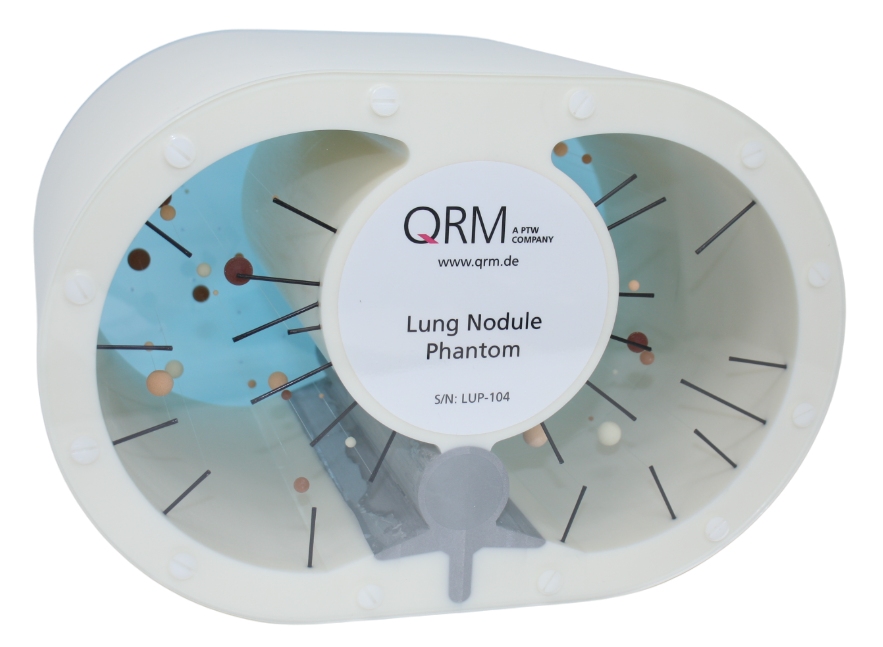
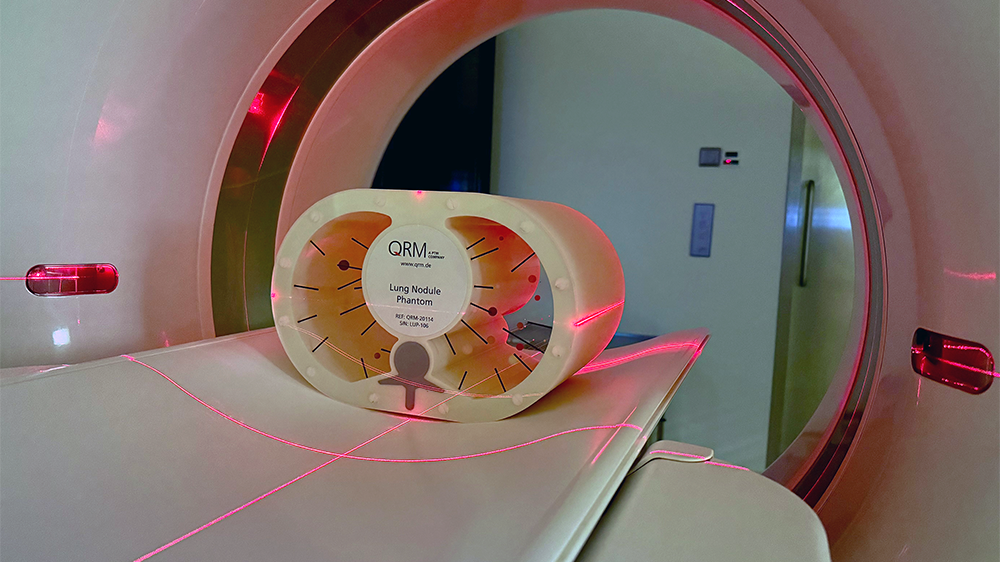
The soft-tissue-equivalent Lung Nodule Phantom by phantom specialist QRM is purpose-built for low-dose lung cancer screening and clinical quality control programs. Its compact, intelligent design incorporates a variety of lung nodules positioned within the pulmonary region, enabling consistent and reproducible assessment of screening performance.

Within the phantom, spherical nodules of varying sizes and densities are randomly distributed across both lung lobes, simulating a wide range of clinical scenarios, including subtle ground glass opacity. This allows clinicians to evaluate detection accuracy under realistic imaging conditions.

The lung material is available as homogeneous or heterogeneous granulate, which users can optionally fill into the lobes to adapt the setup to specific quality assurance objectives. To further enhance anatomical realism, the phantom includes a spine-like structure that mimics cortical and spongious bone, creating a semi-anthropomorphic environment for imaging tests.

Clinical Insights: Quality Assurance with the Lung Nodule Phantom

Practical experience from an external medical physics expert team illustrates how phantom-based testing can strengthen routine QA in low-dose CT (LDCT) lung cancer screening. Uwe Heimann, medical physics expert and CEO of Ihr MPE B+C GmbH, supports multiple clinics and practices across Germany in implementing and maintaining standardized quality control workflows for CT-based screening programs, often across sites with different CT vendors, detector generations, reconstruction techniques and protocol philosophies.

The Lung Nodule Phantom has proven well suited for routine LDCT quality assurance, as it combines established image quality markers with lung-specific test structures addressing key clinical questions in lung cancer screening. The central focus is the reliable detection and assessment of small pulmonary nodules under low-dose conditions, for example at CTDIvol values below 1.3 mGy, within an anthropomorphic setting.

In LDCT, image quality represents a critical balance between minimizing radiation exposure and maintaining diagnostic confidence. The phantom enables this balance to be assessed objectively and reproducibly by evaluating whether lung nodules of varying size, density and contrast remain detectable when dose-reduced protocols are applied. Optional obesity rings further allow assessment of image quality under adapted dose settings in patients with higher body mass.

This clinical relevance becomes even more important when quality assurance services are delivered across multiple sites. Differences in automatic CT dose modulation and dose levels, as well as reconstruction techniques—from iterative techniques to deep-learning-based approaches—can lead to markedly different image impressions. The phantom provides a vendor-independent reference that enables different CT systems to be evaluated under comparable conditions. Protocols can be compared based on the resulting image quality for a specific diagnostic task rather than dose indicators alone (e.g., CTDIvol or DLP).  Using the same phantom across clinical sites supports cross-site harmonization of LDCT protocols, makes protocol adjustments traceable and allows minimum requirements for small nodule depiction to be checked.

For routine, day-to-day use, two aspects are particularly important: clinical relevance and practical handling. Embedded nodules must represent realistic sizes, densities, and contrasts, ensuring that small solid or semi-solid structures remain reliably visible at low dose levels. This advantage is particularly valued by reporting clinicians, as it enables a reality-based assessment of image quality rather than a purely synthetic or abstract evaluation.

Operational efficiency is equally critical — the phantom must be easy to position, quick to scan, and straightforward to evaluate in order to integrate seamlessly into recurring QA schedules. The compact anthropomorphic design of the QRM Lung Nodule Phantom supports an efficient setup, while lung nodules with known positions facilitate faster, more consistent assessments.

Taken together, these clinical insights underscore a key point: in LDCT lung cancer screening, quality assurance benefits from tools that enable realistic testing of scanner performance while remaining practical for routine use across diverse clinical environments.

For further information on the underlying physics and standardized methods for image quality assessment using QRM phantoms, download the QRM Code of Practice.


References:

[1] Eurostat. Cancer statistics – specific cancers. European Union, 2022.

Burcu Hiz Temizer holds a master’s degree in Medical Physics and has over 20 years of experience in the medical technology industry. She joined PTW Freiburg in 2022 and is responsible for the QRM and PTW diagnostic product lines.

Uwe Heimann is a medical physics expert and CEO of Ihr MPE B+C GmbH, a medical physics services company providing consulting support to clinics and professionals. With extensive clinical experience in diagnostic and interventional radiology, his work focuses on the safe implementation and quality assurance of CT protocols, including low-dose lung cancer screening.

This article was originally published in the Summer issue of EMP News (June 2026, EFOMP): Download PDF excerpt.

LDCT Quality Assurance: Key Questions & Answers

A compact summary of the article’s core takeaways in three Q&As — why quality assurance matters in low-dose lung cancer screening, how the Lung Nodule Phantom supports clinically relevant testing, and what benefits it brings to routine QA across different CT systems.

LDCT screening relies on a careful balance between minimizing radiation exposure and maintaining sufficient image quality for reliable nodule detection and assessment under low-dose conditions. As screening programs increasingly use different CT systems, reconstruction methods, and dose protocols, standardized quality assurance is essential to ensure consistent imaging performance and diagnostic confidence across sites.

The QRM Lung Nodule Phantom combines established image quality markers with realistic pulmonary nodules of different sizes, densities, and contrasts. This allows users to assess whether clinically relevant pulmonary nodules remain detectable under low-dose conditions, directly linking image quality assessment to the clinical task of lung cancer screening.

The phantom provides a vendor-independent reference for comparing CT systems, harmonizing protocols, and supporting quality assurance in lung cancer screening programs.  Its anthropomorphic design, realistic nodule structures, and straightforward handling support efficient and reproducible quality assurance workflows, making it well suited for routine use across multiple sites and scanner technologies.

Diese Seite existiert auch in Ihrer Sprache.
This page also exists in your language.
Sprache wechseln Change Language