Product Highlights
BEAMSCAN
Water Phantoms
VERIQA
Patient QA Platform
UNICHECK
Web-based Daily QA
RUBY
Modular QA Phantoms
BEAMSCAN MR
Water Phantom for MRgRT
OCTAVIUS 4D / 4D MR
QA Phantom
Electron Density Phantom
Classical Shape Phantom
Track-it
QA Data Management Platform
flashDiamond
Detector
UNIDOS Tango & Romeo
Reference Class Electrometers
All Radiation Therapy Products
A B C
D
E F
G
H
I
J
K
L
M
N
O P Q R S T U V W
X
Y
Z
Product Highlights
NOMEX
Multimeter
NOMEX
Dosemeter
Track-it
QA Data Management Platform
QRM
Phantoms
All Diagnostic Imaging Products
A B C
D
E
F
G
H
I
J
K
L M N
O
P
Q
R S T U
V
W
X
Y
Z

Employee Stories at PTW

Alena Treyer

Administration

My name is Alena Treyer, I’m 24 years old, and I’m originally from Pfaffenweiler just outside Freiburg. I’ve been part of the PTW family since September 2019. I currently work in accounting and also assist with controlling.

My job is very varied and multifaceted. My primary focus is on accounts payable—I review, post, and pay the invoices we receive from our suppliers. At the end of each month, I also prepare various tasks for the monthly closing.

Another important area is employee time tracking. In addition to recording and correcting working hours, breaks, and absences, we provide time data for payroll and generate statistics for management, HR, and controlling. Currently, I’m also supporting the Controlling department, which makes my role even more diverse: I create reports and statistics and share responsibility for two of our subsidiaries.

I came to PTW through my brother, Jannic Treyer. He completed his apprenticeship as an industrial mechanic here—and as is often the case with older brothers, they tend to serve as role models.

So I, too, decided to pursue an apprenticeship as an industrial management assistant at PTW. After graduating in 2022, I initially worked in purchasing. I moved to accounting in 2023, and that’s where I still work today.

Thanks to various supervisors, it became clear to me early on that I could imagine a future as a manager. My goal is to later support and challenge employees in a similar manner to my own experience.

To ensure that I am well-prepared professionally, I decided to continue my education in 2023 to become a certified accountant. However, it was a major challenge to balance my training and my daily work. Thanks to the support of my colleagues, managers and PTW as a company, I successfully passed the exam in February 2026. I am very grateful for that. Now it’s time for me to put what I’ve learned into practice – because you never stop learning.

I particularly appreciate the flat hierarchies and the fact that we work as equals. Collaborating with other departments is enjoyable because mutual understanding and support are our top priorities.


Above all, my coworkers motivate me. I also have to add that the variety in my job makes every day a new and enjoyable experience.

Marc Damrau

Head of Education & Training

The field of study of medical physics did not exist when I chose a major at the university. That’s why I started working on a ‘normal’ physics major. It was only during my Ph.D. studies that I came into contact with medical physics due to a disease in my family environment. As a result, I became familiar with radiation therapy and learned that physicists are also employed in this area. This was the starting point of my personal interest in medical physics, because this application fascinated me right from the start. Parallel to my Ph.D. studies, I then began a correspondence course in “Medical Physics and Technology” at the Technical University of Kaiserslautern.

During my Ph.D. studies, I already received an offer to get training as a medical physics expert in radiation therapy at Frankfurt University Hospital. I worked in hospitals for a total of 15 years, the last nine years until 2012 as a senior medical physicist in radiation therapy in Hanau City Hospital. Then came a time when I wanted to leave the hospital to apply my clinical experience to the development of measuring equipment for quality assurance. Since I had worked with PTW products throughout my entire medical physicist career, I already knew them very well and was pleased to be offered a job at PTW.

I started at PTW as a product specialist. After three years, I took over as a sales manager for the USA and Canada. During that time, I discovered that I actually cared much more about the clinical application and explaining our products. I had already taught radiographers and medical technologists (“MTRA”) at the university hospital, so the idea crossed my mind to set up an application team at PTW to support our customers and provide internal training for our sales team as well as our application specialists in our branch offices  worldwide. Management considered it a good idea, and now I've been in charge of the “Education and Training” Department since the beginning of 2020. Responsibilities not only include developing educational and training content, but also optimizing technical implementation. Both on-site training events as well as online demos and training sessions, webinars, tutorials and podcasts are now part of our repertoire. The work is very varied, since organizing events is also part of the tasks.


Above all, I like the fact that I am very free in my decisions and that I can contribute many of my own ideas and also implement ideas from co-workers. I have few restrictions in this context. I still appreciate contact with customers. I enjoy working with and helping colleagues from hospitals, most of whom I still know well from my time working there. I like the connection between everyday hospital life and the use of our products at a high level.


In a hospital, I was always fascinated by applied physics and the fact that you can help to optimize the treatment of the patients together with doctors. On the other hand, individual confrontation with patients can be very stressful in the long term, especially when you don’t succeed in helping them.

The motivation of a medical device manufacturer is to optimize their products so they are much easier to use and actually fulfill the requirements and tasks in a hospital. This requires not only technical and physical knowledge and understanding, but also constant feedback from hospitals. A very nice aspect of this is to work in a group in which all parties collaborate and do not work against each other because there are different interests.

I greatly appreciate the flat hierarchies as well as the strong communication and the short decision paths. In addition, I like my co-workers. We are a very good team at PTW, and it is a great pleasure to work there.


You need hospital experience first. Therefore, I would definitely recommend working in a hospital for a few years before embarking on a career in industry. Hospital experience is an essential aspect of a medical physicist. If you have not been able to breathe this air, you cannot really sense what the actual needs and necessities in a hospital are. You have to understand the language of a hospital to find out where the problems are.


Zahra Azadi

Electronical Test Field

My name is Zahra Azadi, and I work in production. As an electronics technician, I work with the testing team to ensure that all devices are tested before they are shipped to customers.

I work as a tester and am therefore responsible for testing all devices to ensure they function properly and are safe to use. If problems do arise, I analyze the causes and remedy the issues through targeted repairs.

When I came to Germany, I learned about the dual vocational training system and was immediately intrigued. I found the combination of theory and practice very exciting. I came across the company PTW through the Employment Agency’s website. I wanted to join a medical company as an electronics technician because that kind of work requires a high degree of precision and is directly related to people’s health. In addition, you work with a variety of different devices, ranging from small to large. At the same time, I find it fascinating that modern medical devices combine many different electronic components. During my apprenticeship, I got to know several departments in production. After completing my apprenticeship, I initially worked in assembly where I populated circuit boards before later moving to the test lab where I work today.

What I particularly like about working here is the supportive atmosphere. Everyone helps each other, and we really work as a team. On top of that, the tasks are varied, so it never gets boring.


What motivates me every day is seeing tangible results and being able to solve problems. It feels great when a device is working perfectly again in the end. Plus, I look forward to working with my team every morning.

Daniela Eulenstein

Research Scientist

I started a basic physics degree without even knowing that radiation therapy even existed. I first started my bachelor's thesis in experimental physics, but I discontinued it and started anew, this time in Professor Björn Poppe's workgroup on Medical Radiation Physics. This new beginning was the best decision of my studies! I was so enthusiastic about the topic that I stayed in the workgroup. Parallel to my master's degree in physics, I started working in radiation therapy and nuclear medicine at Pius Hospital in Oldenburg.

After my studies, I then acquired the expertise as a medical physics expert and worked as a qualified medical physicist at Pius Hospital in Oldenburg. Parallel to my clinical work, I continued to be a member of Professor Poppe's workgroup and did a lot of research during that time, was involved in teaching, supervised many theses and wrote my doctoral thesis – with and about PTW detectors. In 2018, I then “changed sides” and have been working as a research scientist at PTW since then.

I work as a research scientist in the Department of Physical Technical Projects. My tasks are very versatile. On the one hand, I research for PTW, represent the company in research projects and publish scientific articles. I also support product management and have developed the concept for the RUBY modular phantom platform, supported product implementation, performed clinical validation and continue to be responsible for RUBY product management. In addition, I work in our Dosimetry School as a lecturer for theory and practice and also give further education courses in-house.

I particularly appreciate the versatility. My job is very diverse and flexible. I like the contact and exchanges with many hospitals around the world. However, I can also work outside hospitals and have worked for PTW at CERN, for example: a great honor and experience for me!

I'm fascinated by work in hospitals. Physics knowledge can be used directly to do good, because it contributes to the treatment of each individual patient. I find it very satisfying to be directly involved in the therapy of so many patients. In many other fields of physics, you are far removed from the actual application.

In the end, however, I decided to work in industry because there are more possibilities. In my current position, I can visit many more hospitals and learn how radiation therapy is applied worldwide. I am curious about this and I am interested in what different approaches are available. This knowledge can be used in turn for optimizing PTW products. As a result, my work can benefit a lot of hospitals in this way. Although I have much less patient contact, which is a pity, on the other hand it is also positive, because you sometimes have to deal with very sad fates in a hospital that can cause you a lot of stress. This is a long way from being the case in industry.

My clinical experience has convinced me that PTW develops and manufactures the best products in the field of radiation therapy. From the outset, I only considered PTW as possible employer if I decided to turn my back on the clinic and go into industry. It was also very important for me to be able to continue my research after changing careers, and I greatly appreciate the fact that PTW makes it possible for me to do so.

My recommendation is to work in a hospital first and then switch to industry. The reverse order is probably not that easy. If you bring your versatile hospital experience to industry, this is also very valuable for both sides.

Jannic Treyer

Production

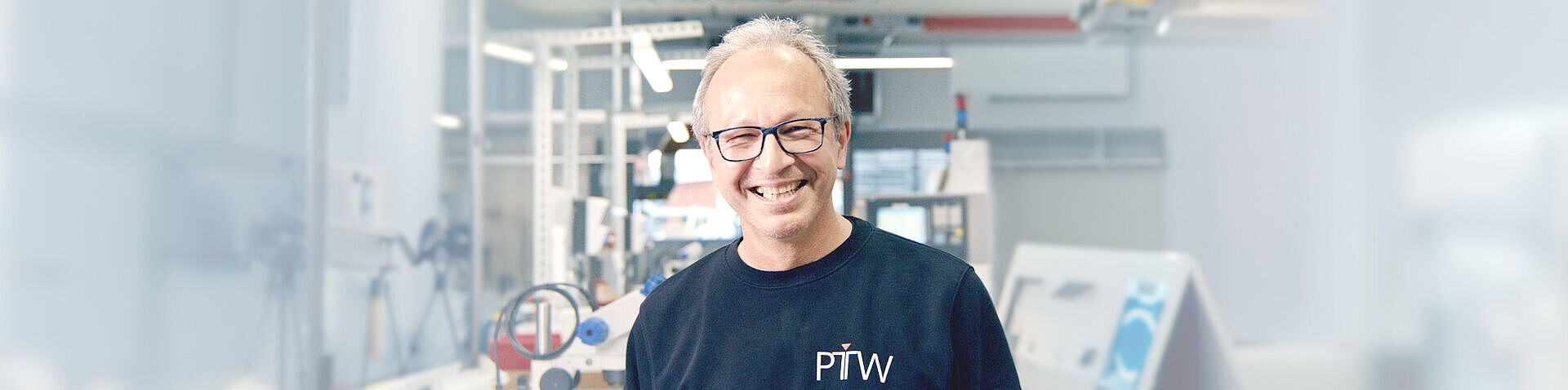
My name is Jannic Treyer. I completed my apprenticeship as an industrial mechanic at PTW and I have been with the company for a total of 10 years now. I currently work at the company’s production site in Umkirch, where I operate large CNC machines.

We operate on a two-shift schedule, alternating weekly between the early and late shifts. I oversee a turning and milling centre where I manufacture components for PTW’s products. My responsibilities include setting up and running the CNC machines, as well a carefully measuring and inspecting the finished parts.

I first learned about PTW through a job advertisement in the newspaper. I then began a 3.5 year apprenticeship and was subsequently hired by the company. I have completed several internal training programs over time and I also work as a trainer for industrial mechanics today.

Currently, I’m operating the largest machine in our workshop, something that makes me especially happy. As well as being technically challenging, it requires a great deal of knowledge and experience.

I really enjoy my work at PTW because it’s so varied. What’s especially motivating is seeing what can be created from raw materials at the end of the day.


I find it really motivating to harness my experience to help drive PTW forward and continuously optimize processes.

Julia-Maria Osinga-Blättermann

Product Manager

I already found physics lessons very fascinating when I was at school. After high school graduation, I initially fluctuated between studying medicine and physics. When researching the possibilities in these areas, I finally came across the medical physics course of study at Martin-Luther University in Halle. This was the perfect combination of the two subjects for me.

When I started working at PTW, I investigated a new trend in dosimetry. I dealt with the relevant technology, conducted extensive literature research, met with research groups and analyzed customer needs. It was a question of finding out whether we would like to develop and offer such a product at PTW. Based on my results, PTW has decided that we will move in this direction.

The second project was about high-precision radiation therapy, i.e., stereotaxy. I developed the first prototypes for the stereotactic QA phantom “Ruby”, which we launched in early 2020.

I find it exciting to investigate new technologies. I greatly appreciate having the time and the freedom to deal with them intensively and to meet and exchange ideas with international research groups and experts from hospitals. A lot of initiative and creativity is required, which I like a lot.

I received an insight into the daily routine of a hospital during my internships when I was studying at the university. The work in a hospital is demanding, but at the same time it is characterized by routine and sometimes shift work. That's why my first choice was to work in industry and develop medical devices after I received my Ph.D.

I like the high demands of PTW on precision and on achieving high measuring accuracy. In my view, this is very valuable and I can identify very well with it.

I think it's great that all departments as well as the production are located in and around Freiburg, so you can interact directly with all your colleagues and be very productive.
There is an informal atmosphere with flat hierarchies. This makes everyday life very pleasant.
At PTW, I also have a relatively large amount of flexibility in terms of working hours. This makes it much easier for me to reconcile family and work and to continue to pursue a demanding career.


I was generally aware of the tasks that a medical physicist has in radiation therapy or research. On the other hand, I did not know much about the possibilities for medical physicists in industry. I could imagine that it is the same for others. I regularly attended conferences at that time, for example the annual meeting of the German Society for Medical Physics. At the industrial exhibition, I asked the exhibitors directly about job opportunities for medical physicists in their companies. I have learned a lot in that way and would recommend it to others. That can not only create an opportunity for an internship, but such contacts can also be worth their weight in gold when you search for a position in a company.

Oliver Schrenk

Head of Customer Success Management

I got into medical physics indirectly. While I was at school, I decided that I would like to do something related to medical technology. So that's what I did. I studied medical technology where I felt most comfortable in physics. That's why I followed up with a master's degree in medical physics after completing my bachelor's degree in medical technology. I stuck with this field and furthered my education with a doctorate.

Since mid-2024, I have held a position in a new area for PTW – ‘Customer Success Management’. I am the head of this department and in the process of building it up. In customer success management, we aim to support customers proactively after they have purchased products and solutions from PTW. For example, we provide support with installation, commissioning, and clinical deployment. The aim is to enable our customers to use PTW solutions in daily clinical practice as quickly as possible. This means I have very close contact with customers, but also with the customer environment (in discussions with third-party suppliers) and provide support with technical and physical issues.


The close contact I have with customers is super exciting. Conversations and discussions take place on an equal level from medical physicist to medical physicist. I can contribute both the company’s and my own expertise, so that the customers who use our products benefit greatly.


I have worked in the clinic both in research and in practice. In the clinic, work is influenced by many parameters due to ongoing operations. There are also many tight deadlines, for example, when work has to be carried out on a device that is used all day to treat patients. In addition, problems are usually short and urgent. If an accelerator breaks down, you have to be quick and act fast because patients are involved. In industry, the problems and issues are often more long-term. This can have both pros and cons. However, what I see as a clear advantage is the greater freedom in industry. Whereas I had to follow fixed routines and guidelines in clinical practice, I can organize my work in industry more individually and can better contribute my own ideas. In my previous position as a product manager, products were developed based on my proposals, which I am now able to support for customers.

I wanted to leave the clinic and get into the industry. And when you work as a medical physicist, PTW is very well-known and has an excellent reputation. Most of the products you know and use are made by PTW. What I appreciate at PTW are the flat hierarchies and the direct communication paths. I have contact with many departments in the company. The interactions are very friendly, uncomplicated and informal. I am also given a great amount of flexibility. I have few restrictions in terms of my working hours. And remote work means I can usually choose where I work. That suits me and my family very well.


In my opinion, training is very important, regardless of whether you plan to work in a clinic or in the industry later. You should take enough time for your training. You may have the chance to finish quickly and take on responsibility immediately, but I would recommend taking the time for comprehensive education. This gives you a sound foundation on which to build on later. You should also try to remain flexible. Especially in the clinic, but also in industry, you can quickly end up in a rut. This can be prevented by remaining open to new challenges and ideas.


Diese Seite existiert auch in Ihrer Sprache.
This page also exists in your language.
Sprache wechseln Change Language